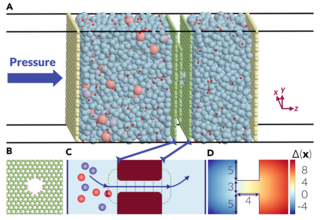
Schematic representation of the model filtration system with the membrane, two pistons, water molecules and Na+ and Cl- ions.
Ensuring reliable access to clean water is a critical global challenge that affects billions of people and will become more urgent with population growth and climate change. Developing effective water-treatment infrastructure is therefore essential, alongside improved water management and new technologies for water reuse and desalination. Reverse osmosis has emerged as a leading method for converting saltwater into fresh water, using semipermeable membranes that allow water to pass while blocking dissolved salts. Continued advances in membrane technology are needed to make this process more efficient and affordable worldwide.
Our group uses molecular simulations to understand how water and solutes move through semipermeable membranes, with the goal of guiding the design of next-generation desalination materials. We develop computational methods to study systems such as nanoporous graphene, polyamides, and metal–organic frameworks, focusing on how molecular structure affects selectivity. These efforts help improve membrane performance and advance the broader understanding of desalination technologies.
Related Work
-
43. Computational Investigations of Ion Selectivity in Capacitive Deionization from Electronic to Device Scales
Dogan A. H., Korkut A. S., Haji-Akbari A., Uralcan B. The Journal of Physical Chemistry Letters 0, 16
-
42. Secondary Finite-Size Effects and Multibarrier Free Energy Landscapes in Molecular Simulations of Hindered Ion Transport
Khalifa O., Shoemaker B., Haji-Akbari, A. J. Phys. Chem. B (2025)
-
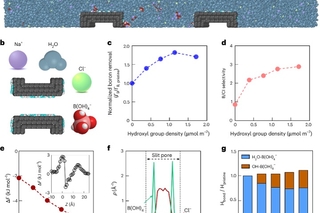
40. A highly selective and energy efficient approach to boron removal overcomes the Achilles heel of seawater desalination
W. Pan, D. Roy, B. Uralcan, S. K. Patel, A. Iddya, E. Ahn, A. Haji-Akbari, J. Kamcev & M. Elimelech. Nature Water (2025) 3, p. 99–109